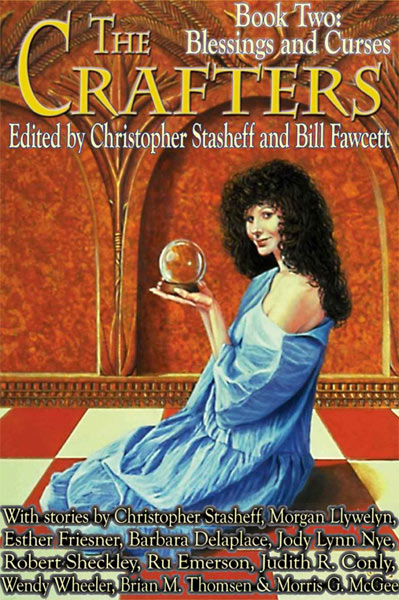
the anthology? Buy the
ebook or paperback at...


WHO GHOST THERE?
Part II
by
Christopher Stasheff
Copyright 1992
London was a mad, exciting whirl as it appeared from the window of Aunt Trudy's carriage. Brief as their acquaintance was, Anthea felt no hesitation at letting her aunt see just how delighted she was with the metropolis. "Oh, Auntie! The Tower itself! Oh, it seems an age since I saw it!"
"An age it has been," her aunt returned. "You were only a child when you left, and you are a young woman now."
"A young woman"—no one had called her that before. The term was sobering—but not for long. Everything looked so much smaller than she remembered it.
"But of course," Aunt Trudy said, "you were somewhat smaller then, yourself."
The enthusiasm and gaiety of the return buoyed Anthea through her introduction to the staff, and particularly Hester, her very own lady's maid—newly promoted for the occasion, and under the constant and unrelenting scrutiny of Aunt Trudy's Abigail.
"Don't fret," Anthea assured her, glad to have someone as nervous as she herself. "If you do make any mistakes, I shan't tell."
Neophyte or not, Hester knew the proprieties, and Anthea had a hot bath to wash off the dust of travel, and a decent dress, not too far from her own size, appropriate for dinner. She felt awkward and gauche under the severe eyes of the butler, the footman, and the maid—but Aunt Trudy put her at ease in minutes, by making quite obvious her delight in having someone to share her meals with again. Anthea hoped she was sincere. It was terrible to think, but she hoped it wasn't mere politeness.
Then, finally, she was in her nightdress and alone in her darkened room, her chocolate cup empty beside her bed, the room shadowed by the flickering light of her candle—and the strangeness began to make itself felt. Surprising as it was, Anthea realized she was longing for Windhaven. "Oh, Sir Roderick," she whispered, "if only I could speak with you now!"
"Why, then, do, Miss Anthea," said the familiar old hollow voice.
Anthea started, nearly leaping out of her skin. "What... Sir Roderick!"
The suit of armor gleamed in the shadows by her wardrobe. "Why, poor child! I've frightened you. Forgive me—I thought that surely you would remember that I could travel to haunt the family wherever they went."
"Of… of course." Anthea sat up a little straighter in bed. "Yes, how foolish of me! I should have remembered! Oh, Sir Roderick, it is so very good to see you!"
"And you, dear child. Surely you did not think I would lose your company if I could prevent it."
"Oh, you are so good! But… Sir Roderick, I am no longer a child."
"Of course not, my dear." The suit of armor came over to sit on her bed. "That is why I addressed you so. When you were a child, I called you 'little mademoiselle'—so now, when you are grown, I feel free to call you 'my child.' After all, we are related."
"And I was so grateful for the courtesy then," Anthea laughed. "Shall I be grateful to be called 'child' soon?"
"Yes, and that day is not far off, I believe. Still, I'll call you 'Miss Anthea' until then. May I advise, though, that you only think the words when you address me, rather than speaking aloud? I assure you, I'll hear you just as easily, and the servants might wonder at hearing you speak with a man in your own chamber."
"Oh yes, of course!" Anthea immediately shifted her conversation to thought only. / think I can sleep well now, knowing that you are near.
"Why, thank you, Miss Anthea. Are you sleepy, then?"
Well... not very.
"Yes, I know—discovering my presence was a bit of a shock. Might I suggest a game of chess, then?"
The very thing! Anthea scrambled out of bed, careful to keep her nightdress down, and ran to take out the chess set she had brought with her. She scrambled back into bed and opened the board, laying out the pieces.
The candle burned down before she had him checkmated, but the glow from his armor was quite enough.
There followed a positive whirlwind of shopping, and Anthea came home in quite a giddy mood for the first three days. Aunt Trudy seemed to be enjoying herself just as much as Anthea was; she confided, over dinner, that the shops and modistes had all become new to her again, simply by watching Anthea's delight in them.
The next day, Aunt Trudy embarked on a round of visits, calling on friends with Anthea and seeing her properly introduced. She met a dozen girls of her own age or nearly, and if some of them were calculating in their assessment and attempted to patronize her, the others more than made up for it with their quick and ready warmth. Half a dozen of them came to Aunt Trudy's to help celebrate Anthea's birthday on the twentieth of April, just before the beginning of the Season—and the next day, invitations began arriving. It seemed that Aunt Trudy's friends included several of the patronesses of Almack's, and Anthea had passed their inspection. She was about to be launched.
Her first ball was to be at Lady Fortrain's. She spent hours with Hester, dressing and powdering and primping—and was too nervous to eat more than a few mouthfuls at dinner. Aunt Trudy was quite impossible, urging dish after dish upon her with a roguish twinkle in her eye. However, she more than made up for it by whisking her away wrapped in an ermine-trimmed cloak, into the carriage and off to the ball. Anthea felt quite like Cinderella and had half a mind to accuse Aunt Trudy of being a fairy godmother. If she didn't, it was half because she feared her aunt might confess to the truth of it. However, she did remember herself enough to say, "Oh, Aunt, how can I ever repay you for this!"
"You may reimburse me when your lands have begun to yield a profit again. For the present, you may gladden my heart with your own joy."
Anthea looked stricken. "But, Aunt—to repay Papa's debts, and undo the damage of neglect, will take eons!"
"Only decades, my dear, and I look forward to a weekend at your house when it has been suitably restored."
"Oh, of course, whenever you wish! But, Aunt..."
"It is only a loan," Aunt Trudy said firmly, "and you are not to trouble your head about it. Affairs of this sort are the privilege of... maturity. Yours are flirting and laughing and filling a house with music. I pray you, do it well."
Anthea gave up and flung her arms about her aunt, knowing her generosity for the charity it was, and loving her all the more for not admitting it. "But I will never, ever, be able to repay your kindness!"
"Then you will have to repay it to some other young thing who needs it." Aunt Trudy whisked out a handkerchief and dabbed at Anthea's cheeks. "There now, child." And she gave her a quick peck on the cheek.
Lady Fortrain's mansion was lit up like Guy Fawkes' Night. The stream of carriages passing in front of the door was in almost constant motion, each pausing for a few minutes to discharge its passengers, then moving away to find a place to wait. Coming into that line was another matter, of course—drivers cracked whips and cursed at one another as they jockeyed for position. But inside the carriage, Aunt Trudy sat serenely and calmly, while Anthea fluttered back and forth from window to aunt, exclaiming, "Oh, how lovely! So many lights! So many beautiful dresses!"
"You don't remark, or seem to remark, upon the people, Anthea," she was corrected.
"Oh, how can I, Aunt? They're too small to see!"
"Don't fret yourself, you'll soon be close enough to view their faces quite well, I assure you."
She was indeed, close enough to face the redoubtable wall of respectability represented by Lord and Lady Fortrain, who greeted her formally and Aunt Trudy warmly. It was strange how their formidable aspects dropped when they began to chat with Trudy.
Freed from the constraint of her aunt's presence, Anthea joined a gaggle of her new friends, to giggle and glance at the gentlemen.
"Oh, do look at young Lord Melchoir, Anthea! They say he has twenty thousand a year and squanders it all in utter dissipation!"
Anthea stared. "One would never think it, to look at him. He looks quite the picture of health and virtue!"
Ermingarde gave a peal of laughter. "Virtue! The only virtue he may have is whatever he steals! Yet they say that Lord Delbert, who makes every attempt to appear the absolute rake, is actually quite honorable in private!"
"Oh?" Anthea smiled. "And how would they know of his private affairs?"
"My dear, affairs can never be truly private! Except, perhaps, for those of Mr. Crafter, there."
"Oh, but he is not truly a gentleman!" Jane objected. "Truly, he may be quite wealthy—but not a cent of it was he born with—it is all come from trade!"
"Nevertheless," Sophie said, "he comes of good family. His cousin is a baronet, after all."
"But such a distant cousin, my dear! And this Crafter is actually from the Colonies! America, of all places! Really, one cannot but think he would be more at home in moccasins and a hat made of some small animal than in cutaway and breeches!"
Anthea eyed the young man in question, seeing blond hair with a surprisingly dark skin, standing by himself, quite self-contained, but with an air of interest that seemed somehow forced.
"American? Is he a spy, then? They favor Napoleon?"
"No, by some irony, he served in Her Majesty's Navy, they say—but one never knows, does one? After all, it has been only years since we began the war with the French! If you can call the current situation a war," Ermingarde said as an afterthought.
There was something vaguely sinister about the young man, Anthea thought. "Is he the only eligible bachelor who is not leading a secret life of dissipation?"
Her friends giggled, and the conversation turned to speculation as to who would dance with whom. It was short-lived, however, as one by one, the young men came over to bow and praise, and ask for the compliment of a dance. Before long, Anthea's friends were whirling away to the music, each with several dances already bespoken. Anthea watched and smiled, and tried not to feel too envious.
"Miss Gosling."
Anthea looked up, startled. "Lady Fortrain!" The imposing dowager forced a slight smile. "May I present Mr. Roman Crafter, late of the exotic lands of the East."
The young man bowed and Anthea suppressed a slight shiver. So close, she found that he fairly exuded an air of worldliness which she found more repulsive than attractive.
"Your aunt has told me of your interest in geography," Lady Fortrain went on, "so I thought you might wish to learn of Mr. Crafter's experiences in India."
"India! Oh yes, Lady Fortrain, thank you! Really, Mr. Crafter, how did you come to India?"
The grave young man gazed directly into her eyes with such a deep and probing look that Anthea had to suppress a shiver. "It was in the course of private curiosity, Miss Gosling, though it came to be on the King's business."
Lady Fortrain smiled benevolently and moved on. Anthea rather wished she hadn't; there was something decidedly unsettling about Mr. Crafter—perhaps the steady gaze of those large, surprisingly light gray eyes, so fitting beneath the mane of ash-blond hair—or perhaps it was his excessive leanness, or the bronze hue of his skin. All in all, he gave the impression of someone left out in the sun too long, which he may well have been. Most probably, though, it was the aura of almost fanatical intensity that seemed to surround him like a cloak.
But he was immaculately dressed, his neckcloth pristine and precisely folded, and she certainly had his undivided attention. "I confess to puzzlement, Mr. Crafter. How could private curiosity turn to royal affairs?"
"By the press of events, Miss Gosling. But really, may we dance while I tell you of it? I should very much like to."
"Why, thank you." Anthea took Crafter's arm and stepped out onto the floor, repressing a shudder at his touch. As they began to move through the paces of the dance, his eyes never left hers, and to ward off his intensity, she pressed, "Do go on, Mr. Crafter. What were these events that took you to India?"
"That was a matter of trade, Miss Gosling, as much as of curiosity."
She was surprised at his boldness in so openly admitting to being in trade. He seemed almost brazen, in fact. "Trade, Mr. Crafter? Has your family no land, then?"
"Why yes, a considerable amount, and they are ever acquiring more, I understand—though it's rather inaccessible to me, being in America."
Brazen indeed! Would he proceed to tell her to which spymaster he reported? And why did he make no mention of his English relations?
"I was chosen to serve in His Majesty's Navy," Crafter explained, "and given very little choice in the matter."
"You mean you were—impressed?" She was shocked—and somewhat thrilled.
"My father was, actually—we were passengers aboard a ship bound for Jamaica. The captain of the man-o'-war that overhauled us thought Father would do splendidly as an able-bodied seaman, never mind that he was en route to represent the Government of the United States in a Crown colony—and thought I would do as a powder monkey, being only ten at the time."
"A common seaman?" Anthea gasped.
"Not willingly, I assure you. I was privileged to take part in the battle of Trafalgar, though I can't claim to have seen anything but the powder supplies and tunnels, and the wounded. Through a rather unique set of circumstances, I was fortunate enough to be able to contact some relations of mine..."
"Not a baronet, by chance."
"Ah, you have an ear for the gossip! Yes, I've a cousin of that rank, though it was the squire in Ireland who bought a commission for me. That protected me from the worst of the life of a foremast hand and gave me a pittance to save in the bargain. I sold out when I attained my majority, repaid my cousin, and invested in the British East India Company."
Anthea found it interesting to note that there was an Irish cousin that gossip did not speak of—but then, one frequently didn't speak of the Irish. "How did this lead you to India, though?"
"I desired to be sure my money was being put to good use."
"To be sure of it! Really, sir, if one cannot trust the East India Company to increase one's money, whom can one trust?"
"No one, I begin to think—for the mismanagement and nest-feathering I witnessed were quite disheartening. I determined to take a hand in affairs and managed to impose some discipline—but in the process, I became an informal envoy to a rajah's court."
"A rajah!" Anthea breathed, all agog.
"A small one," Crafter temporized, "though his palace was large enough, and had the requisite peacocks to announce visitors—and if I can't speak of piles of jewels to either hand, I can at least assert that his wives did seem to be entrusted with a substantial portion of his capital."
Anthea laughed almost in spite of herself, and Crafter responded with a smile of amusement. "The Rajah, it seemed, wished to forestall the incursions of the Company by treating directly with the governor-general, who is at least nominally in the service of the Crown as well as commerce—so there I was, a subject of His Majesty and an emissary to him, one and the same."
Anthea laughed again and would have liked to ask him more, but the music ended and Crafter stepped back, releasing her hand with a bow. "Thank you for the dance, Miss Gosling. May I look forward to repeating the pleasure?"
"I... I think perhaps the third gavotte." Anthea examined her programme carefully, which was rather difficult, as it was completely blank. However, she inscribed Mr. Crafter's name, then curtseyed and said, "Thank you for your fascinating conversation, Mr. Crafter. I shall look forward to more accounts of your exotic adventures."
Crafter smiled and bowed again, then left her—and her friends flocked around immediately.
"Really, the Man of Mystery himself, Anthea!"
"Did he tell you of murderous deeds and mysterious doings?"
"Is he as ominous as they say, Anthea?"
"You laughed quite well, Anthea. Was he truly amusing?"
Then everyone fell silent at the approach of three gentlemen, and someone drew breath rather sharply, for at their head came Lord Delbert, his eyes sparkling as brightly as the diamond in his neckcloth, crowned with a mane of raven hair, his bright blue eyes seeking out Anthea as he bowed. "Miss Gosling! May I have the pleasure?"
Her friends stared as Delbert led her out onto the floor, and Anthea thought he must surely hear the pounding of her heart.
"Where have you been hiding, Miss Gosling?" Lord Delbert asked. "You have never graced London before."
Anthea gave a little laugh. "Not since I was ten, your lordship. We have been living in Kent in the interim."
"How naughty of your parents, to hide away so dazzling a beauty!"
Anthea's face flushed with pleasure, though she told herself it was only empty flattery. Still, she knew that she was pretty enough, and that the light of the massed candles showed the auburn glints in her hair to their best advantage. "La, sir! You must not speak so!"
"No, I must, for beauty deserves tribute. Do you remember much of the town, Miss Gosling?"
"Only Saint Paul's and Saint James's, Lord Delbert."
"Then you must allow me to show you more of it! There are such brave sights, Miss Gosling. We must begin with the Park…"
By the time the dance ended, he had claimed three more, and had cajoled her promise to allow him to call on the morrow and take her driving in his phaeton.
On the way home, Anthea chattered and exclaimed without pause. Aunt Trudy listened with a fond smile, prompting her with a question whenever she seemed to be slackening. She was only just beginning to run down as they came home. When they had come in, though, and the footmen had divested them of their cloaks and the maid had brought them Cambric tea, Anthea finally realized that Aunt Trudy had been much more silent than was her wont. "Did some aspect of my evening trouble you, Aunt? My dances with Mr. Crafter, perhaps?"
"Crafter? Pooh!" Aunt Trudy waved him away. "A pleasant enough gentleman, certainly, though contaminated with the aroma of trade. There is some justification for him in the rumor that he enjoys it as other men enjoy their horses or cards, but it is nonetheless declasse. Still, he is impeccable in his conduct, to the point of dullness."
"Then is it..." Anthea swallowed. "Lord Delbert?"
"Delbert has the face and form of an angel, and the tongue of a devil," Aunt Trudy said, frowning. "There is nothing to be said against him, of course—he comes of excellent family, and has never been observed to be improper. Still…"
Anthea's heart plummeted at the 'still.' "
"There are rumors," Aunt Trudy went on. "Nothing definite, you understand, all very vague, but there is some question as to why he is still a bachelor in his thirties."
"No doubt the arrow of love has never found his heart!"
"Or has found it all too often," Aunt Trudy said grimly. "I wouldn't dream of denying you his company, Anthea—but I would urge caution."
Aunt Trudy had good reason to recommend wariness. Nonetheless, Lord Delbert called the next day, and his conversation and bold gaze quite thrilled Anthea until her blood seemed to bubble in her veins. His visit was almost concluded, and he was soliciting again her promise to drive in the Park with him that afternoon, when the butler brought in Mr. Crafter's card. Aunt Trudy looked up and nodded, and the butler bowed and departed. Lord Delbert, however, seemed not to have noticed, so he was still chatting with Anthea quite amiably when Crafter appeared in the doorway. Lord Delbert looked up and rose to his feet as Crafter presented himself with a smooth and somehow sinister grace that flowed into a bow. "Lady Brock, how good of you! Miss Anthea, a pleasure! And yourself, Delbert."
"Bit out of your territory, aren't you, Crafter?" Delbert said with a devilish grin. "Too far from the counting-house by half."
"A distance which I would recommend to you, milord," Crafter said, returning the smile.
Delbert flushed angrily, to Anthea's surprise, and turned to bow to her. "Until this afternoon, Lady Anthea."
"Until then, my lord," she murmured, and he rather ostentatiously kissed her hand, then turned away.
Puzzled, she turned back, to see Mr. Crafter following Lord Delbert's exit with amusement in those gray eyes.
"Please be seated, Mr. Crafter," Aunt Trudy urged. Anthea drifted into a chair.
"Thank you, Lady Brock." Mr. Crafter sat. "I fear I have clouded a bright morning."
"Not at all," Aunt Trudy said briskly. "I am sure Lord Delbert is far more entertaining in the phaeton than in the drawing room. Tea, Anthea?"
"Yes, thank you, Aunt." Then Anthea fell silent, at a loss for a topic.
Mr. Crafter slid smoothly into the momentary silence. "Are you enjoying the Season, Miss Anthea?"
"Oh, yes! It is so gay, even festive! Really, I am so glad to be back in London!" The statement gave her the idea for a possible topic. "And yourself, Mr. Crafter? Did you find your return to London pleasant, or would you have preferred to remain in India?"
"I assure you, I blessed the cool breeze of England," Mr. Crafter said, smiling. "India has its attractions and fascinations, but it is, when all is said and done, alien, and I found I'd no wish for it to be otherwise."
"Did you tire of it, then?"
"For the moment," Mr. Crafter said judiciously, "though I would not be loath to return at a later date. It is not one large country, you see, but a host of small ones. I saw only a tenth of it, perhaps not even that."
"But their customs! Surely they don't differ from one kingdom to the next?"
His eyes brightened; she realized, with a start, that he hadn't expected her to know that many of the independent states in India were sovereign kingdoms. "There are small differences between neighboring countries, but there are great ones between the North and South…"
And they were off into a discussion that was, in its own way, as fascinating as Lord Delbert's visit, though much less exciting. Anthea found, to her surprise, that Mr. Crafter listened to her opinions with respect and never contradicted them—he only narrated such of his own experiences that confirmed or denied what she had read. Aunt Trudy finally had to call a halt to the conversation, though she confessed that she herself was loath to. Nonetheless, the ladies did need a few hours to prepare for the afternoon, so Mr. Crafter was dismissed. He did not, upon his going, kiss Anthea's hand, or even try to—but he looked long and deeply into her eyes, and said that he hoped they would have occasion to chat again. Then he bowed to Aunt Trudy, and departed.
"A man with a somewhat checkered past," Aunt Trudy sighed, "but a fascinating one! Though I fancy most your age would find his accounts boring, Anthea."
Anthea was rather surprised to find that she hadn't.
The drive in the Park was a scintillating pleasure, the more so since several women they passed looked rather nettled to see her in Delbert's phaeton—but after the third such glance, Anthea did begin to wonder as to the nature of their envy. Was it only that they wished to be where she was—or that they already had been? Of course, a gentleman might drive with any number of young ladies, in fifteen Seasons—but had there been more to it than a drive? And there were the half-dozen who took one look at Delbert and turned their faces away, driving resolutely past him with stony gazes. That seemed to amuse Delbert, but he made no mention of it, only kept up with his stream of lively and amusing gossip, setting Anthea alternately to laughter and exclamations of disbelief.
But when they came home, he assisted her down from the carriage with both hands and did not let go, but stood looking down into her eyes, his own with such a glow as to set her heart a-flutter, then pressed his lips to her hand in such a way that she knew he aspired to higher things.
So it went for several weeks, Lord Delbert's visits exciting and stimulating to the emotions, Mr. Crafter's stimulating to the mind—and if Lord Delbert's attentions aroused feelings that not only exalted Anthea but also somewhat frightened her, Mr. Crafter's were oddly soothing and reassuring.
Her life was not a perfect whirlwind of suitors and gatherings, though—there was responsibility, too, as she found out when she noticed how pale and wan her maid, Hester, appeared one morning. "Are you ill, Hester?" she inquired.
"No, not at all, miss. Just too late arising this morning, it would seem."
"Didn't you sleep well?"
"Oh, well enough, I suppose, miss." But Hester was growing more and more agitated, and now that Anthea looked, her eyes were red-rimmed and swollen—not terribly much; rather as though she had bathed them in cold water to reduce the swelling, but still noticeably.
She caught her maid's hand and softened her tone. "What is the matter, Hester? Truly, you may tell me without fear."
Hester hesitated, irresolute.
"I swear I shan't betray you," Anthea pressed. "But if there is trouble, do tell me of it! Two may see a way through where one would not."
Then the floodgates sprang open and Anthea was alarmed to find herself the crying-pillow for her own maid. She consoled and comforted as best she could, and when the wave of tears had slackened, the story came out between sobs. It was a footman of another household who was the cause of the problem, it seemed. Hester had met him when the two households had joined for holiday festivities, and had fallen in love straightaway. He professed that he felt as she did, and pursued the matter with all the eloquence and soulful looks at his command. Swayed by passion as well as love, she had yielded to his pleading, then had been horrified to discover that she was with child. Her lover had been even more horrified, protesting that he could not wed her until he had gained the rank of butler, which was still several years away. When she had pointed out that the child would not wait so long and that she would lose her place because of it, he had retorted that he had no desire to lose his place, and had told her to "take care of the thing."
"Oh, but you mustn't!" Anthea cried, aghast even though she wasn't quite certain of the meaning.
"I would never think of it, miss," Hester replied, eyes dry but swollen thoroughly now. "I shall bear the babe if it is my last living act—but, oh! How am I to manage? Your aunt would throw me out into the street if she knew! What am I to do?"
Anthea hesitated between fear and propriety for a moment, then clasped Hester's hand firmly and said, "You must have faith in your mistress."
"Oh, I do, miss! What do you bid me do?"
"Not just myself, Hester—Aunt Trudy."
"Oh, no, miss!" Hester pulled her hand free, shrinking away. "She'd fly into a rage if I told her! She'd cast me out on the instant!"
"She would do no such thing," Anthea said firmly. "You know her, Hester—she is a kind and understanding person, who would never condemn another woman for being swayed by love. Come, we must tell her." And taking Hester by the hand, she swept her off, protesting, to Aunt Trudy, her confidence in her aunt so great as to surmount any doubt.
That confidence was not misplaced, though Aunt Trudy was saddened by the news, then lectured Hester on her folly. Hester, to her credit, only acknowledged the truth of her employer's words and asked Aunt Trudy's pardon, which was given instantly. "But what are we to do with you, girl? We can't have you staying here to suffer the ridicule of your fellow servants, and have your shame known to the world."
Hester's eyes filled again. "I would never think of shaming you, milady."
"Nor would you ever do so." Aunt Trudy embraced the poor maid. "You are of my household, Hester, and it is not my custom to desert my people in their hours of need. But where shall we send you when your condition can no longer be hidden?"
"Aunt Trudy?" Anthea said diffidently.
"Yes, child?" Aunt Trudy looked up. "She is your maid, after all, and you must accept some measure of the responsibility for her well-being. What can you recommend?"
"Send her home. To my home, I mean—to Windhaven."
"The very thing!" Aunt Trudy clapped her hands. "None know you there, Hester, and Heaven knows there's need of you. The housekeeper is compassionate and gentle, I've seen to that—though she's stern about duty, mind! Your secret would be safe there, and we can legitimately send you to see to your mistress's affairs for several months—really, there wasn't a single room in the house fit for a young lady, and you've wit enough to see to the transforming of a suite, Hester. The babe will be safe there—"
"Oh, yes! It was a wonderful place to grow up!... Your pardon, Aunt," Anthea said, lowering her eyes.
"Given gladly," Aunt Trudy replied. "There are tenant families who would be glad enough to have one more if there were a little money to help feed it, and if you're minded to have the child adopted. However, there are also wet nurses available to tend it, if you don't wish to give it up but have it reared in the manor. For you know, Hester, that we'll expect you back in London within the year."
"I would want nothing more, milady! Oh, thank you, milady!" And the tears flowed again, but this time it was Aunt Trudy who took the maid into her arms and risked water-spotting her gown.
Life proceeded at its normal, and rather dizzying, pace; Hester remained in attendance on Anthea, for it would be a few months more before her condition was so pronounced as to require her removal. Anthea found that there was a bond of sympathy established between herself and her maid now, and she felt free to confide in Hester, especially in regard to her feelings about her two foremost suitors. She did not explain, though, that she rather hoped neither of them would encounter Sir Roderick, for she didn't believe Hester would be reassured to learn of the family ghost of Windhaven Manor just yet. Besides, Sir Roderick had assured her that only family, or those extremely gifted with that Talent the Celts termed "fey," could see him. There seemed little danger of that, though, for Sir Roderick had been oddly absent since the Season's beginning. To be fair, Anthea would have had to admit that she hadn't had time to chat with him, and he apparently didn't want her to slacken her breakneck course.
Lord Delbert's attentions became more and more ardent; he began to steal a kiss in the garden, and in the drawing room, when Aunt Trudy was absent—kisses that became longer, his tongue dancing lightly over her lips in a pattern that sent thrills coursing through Anthea's whole body. She knew she should have slapped him, told him to desist—but was afraid that he might.
Mr. Crafter, on the other hand, was unhappily the soul of propriety—Anthea could have wished for the opportunity to compare his kisses with Lord Delbert's. He did, however, spend more and more time looking soulfully into her eyes, and once, when she protested that a man of such broad experience and depth of learning should find an unlettered chit like herself to be boring, he assured her, "Nothing could be farther off the mark, Miss Gosling. You are astonishingly well-read for so young a lady, and have a lively and inquiring mind that entrances me." Then his gaze sharpened in that disconcerting intensity of his. "But more—there is some quality about you that attracts me mightily, as the steel to the lodestone. You have some element of empathy that far exceeds that of most people, and I suspect you have an inordinate sensitivity which you are at pains to hide." Anthea felt alarmed, and her face must have shown it, for he broke the tension with a puckish smile. "Besides, you're the best opponent at chess I've had in many a year. Will you play?"
She would, but she found herself wishing that it had been another game to which he had invited her. She wasn't quite sure what it was, but she wished it.
It was Lord Delbert who named it, one night when Aunt Trudy was detained with the housekeeper. He pressed Anthea to him, kissed her far more passionately than ever before, then whispered, "I can no longer live without you—I must have all your favors at once, and for all my life! Run away with me tonight, to Gretna Green!"
And Anthea, to her shame, said yes.
Delbert swore her to silence, claiming that if Aunt Trudy knew of it she would prevent them for more months than he could stand—that he would positively wither away from unrequited love. Anthea doubted that, but she was as impatient as he for the wonders his presence promised, though she wasn't certain what those wonders were; so she refrained from telling her aunt, though she felt dreadfully guilty in doing so.
But she had to tell Hester, of course. After all, she couldn't have packed by herself.
Aunt Trudy had to attend the soiree, even though Anthea had a headache—it was, after all, a social obligation. As soon as she heard the carriage depart, Anthea was out of bed and changing into her traveling clothes. She felt horrible at deceiving Aunt Trudy, who had been so good and kind to her, but Love was master of all, and surely her aunt would understand when she came back wedded to one of the most eligible bachelors of the ton.
She and Hester dragged the portmanteaus down the back stairs. There, in the mews, was a carriage, with Lord Delbert, all smiles, right beside it. Anthea hesitated at the sight of the enclosed vehicle, knowing she would have no chaperone—but when Lord Delbert swept her up in his arms, kissing her deeply, the blood began to pound in her veins, and she knew that the love for him that ached in her breast was all that truly mattered.
Then they were in the coach, and Anthea caught a bare glimpse of Hester waving as they were whirled away. Then Delbert's lips closed over hers again, and she could think of nothing else.
It was the most romantic evening of her life—champagne and passion in a closed coach, kiss after kiss, growing more giddy and more silly as the miles passed. At some point in all the jesting and jollity, she mentioned how he would love Windhaven, as soon as it was restored. He seemed to still beside her then. "Restored? Is it so awfully rundown, then?"
"Oh yes, and buried under a mountain of debt! But Aunt Trudy tells me that it will yield income again, in ten or twenty years."
"But surely you will inherit from her when she dies."
"Perhaps something, though I wouldn't wish to claim it, she has been so wonderful to me already. But she has two sons and two daughters, so of course the bulk of her estate must go to them." She suddenly realized what she was saying, and gave a self-deprecating laugh. "How silly of me, to discuss such mundane matters!"
"I am fascinated with every word that drops from your lips." Lord Delbert turned away; a cork popped, and liquid poured. It was a moment longer before he turned about again to offer her another glass. There was more champagne and more passion then, his kisses becoming ever more ardent—then a sudden unaccountable weariness came over Anthea.
"It is the strain and the excitement," Lord Delbert soothed. "Sleep, my love. I would have you fresh and vivacious when we arrive at the first inn." Then waves of sleepiness engulfed her, and Anthea drifted off into dreams of bliss.
Anthea, waken! came Sir Roderick's voice in her mind. The dreams had become more and more carnal; she dreamed of lips pressed to her naked flesh, light fingers caressing her until she ached with longing. But Sir Roderick's voice was commanding, and she wakened, though her head throbbed and the whole world seemed shrouded in fog. She wondered that the wine had been so strong—then realized that those light fingers were caressing her in more than dreams, in the very life, far more intimately than they should, and Lord Delbert was gazing down at her with a smile of rapt delight—and not at her face. His breath was coming in ragged gasps, and his face was flushed. She cried out in shock, and he looked up at her with a devilish grin. "Wakened so soon, my pretty? Well, that will only add spice to the adventure."
"But, my lord… Gretna Green… can you not wait…?" Though part of Anthea wished he wouldn't.
Delbert threw back his head and laughed, and there was a note of cruelty in that laughter. "Foolish girl, there will be no Gretna Green! What need have I, a lord, of a ceremony?"
Anthea stared, electrified. "But… love..."
"Say 'money,' rather. I'm ocean-deep in debt, silly wench, and need a rich marriage to bail me out. The rumors said that you had estates—they mentioned nothing of debts! Still, if I cannot have relief of one kind from you, I'll have another."
"My lord!" she protested, flinching away—but his arm prevented her, circling behind her. "My aunt!" she cried. "Your reputation in the ton..."
"And would you be foolish enough to speak of it? I assure you, none of your predecessors have! Though even if you did, what matter? I'm finished in London, anyway, if I can't have a sea of silver right quickly. I shall have to leave to wander the Continent, so what matter Society now? Be sensible, wench, and lean back and enjoy it, for you'll not have such another night again!"
She didn't doubt that, though not as he'd meant it. She remembered the young women with stony faces and realized, with horror, that she was about to join their ranks.
"Don't tell me that you had no notion of this," he said with a sneer, "for I could tell by your kiss that you had mind for one thing only."
"I never had! Shame on you, sir, to think so of me!" Then Anthea realized that the motion of the coach had stopped, that it was still. "Where..."
"On a country track far to the north of London, my dear, and the coachman has taken the horses some distance away. There will be none to disturb our lovemaking."
"My lord, if you love me, you will wait!"
"Love?" Delbert's lip curled in a cruel sneer. "What is love but the yearning of body for body? Don't tell me that you haven't felt it, my lass, for I've known the heat of your body and the pounding of your heart—here, even here." The cupped hand tightened. "I know what kind of girl you are, Anthea, even if you do not—and your being here, alone in a closed coach with me, gives proof of it!"
"No!" she cried, trying to writhe away from him, but the arm that was curled about her tightened, holding her securely, as he laughed.
A delaying tactic, my dear. A wager, Sir Roderick's voice said in her mind. A game of chess.
Anthea's heart leaped to know she was not alone, though she blushed with shame at the thought of Sir Roderick's witnessing her disgrace, and knew there was little he could do. But it was even as he said—the longer she could postpone the inevitable, the less inevitable it might become. "A wager, my lord! A game of chess! If you win, I shall not resist you—indeed, I shall surrender myself to the passions you claim to detect!"
"A wager?" Delbert drew back with a gleam in his eye. "That might add spice to the encounter. Chess, d'ye say? Foolish child, do you think you could best me?"
"It might heighten the pleasure, as you say," Anthea said, her voice trembling.
Delbert heard; his grin widened. "And my forfeit, if—ha, ha!—I should lose?"
"Then you will let me go, my lord, unharmed and intact, and will say nothing of this night's doings to anyone."
Delbert frowned, but the gleam remained in his eye. "High stakes, but why not? I've played for higher. Where are your chess pieces?"
They were in her portmanteau, and she had them out in a trice, managing to rebutton her bodice as she did. She laid out the pieces, then began the longest game of her life—not merely because of the suspense or the stakes, but because, as Sir Roderick's voice pointed out to her:
He will never let you go unmolested, even should you win. Your only hope is to prolong the game—the longer, the greater the possibility of rescue.
She saw the truth of it in the anger that flashed in Delbert's eye when she took a pawn. Thereafter, she was careful to lose steadily, never taking a piece of his unless she had lost two of her own, but prolonging each capture as much as possible. Meantime, she tried to ignore the caresses of his voice as he described the pleasures she would experience when this opening game was over, and tried to fight against her body's longing to surrender. Yet when she grew too distracted, Sir Roderick's voice was ever there, counseling, pawn to queen's knight six… king's bishop to queen's rook five… Beware of pawn take at queen's bishop four…
Three hours passed, and Lord Delbert began to frown. In fear, Anthea sacrificed two pawns and a knight, though she had to call his attention to the latter. "This game tires me," he growled ominously, and Anthea's heart thudded, for she knew she dared not lose. She began to win, and Delbert to grow darker and darker of mood. Then, when he had only a rook and a knight left to his king, while she had two rooks and won her queen back, he snarled and threw over the board. "Witch! You could not have brought that to pass! Come here, and I shall show you the glories of the path to your master!" And he surged toward her, hands outstretched.
Anthea screamed and threw herself at the coach door, knowing it was futile, that she could never wrench the latch open in time—but Sir Roderick had been at work, and the panel gave way. Delbert's rush carried them both tumbling out of the carriage. Anthea fell clear and bruised her head, but Sir Roderick's voice beat through her brain, and she found her body lifting from the ground. Run, child! As far and as fast as you can!
She had a brief glimpse of Lord Delbert, half in and half out of the coach, cursing and thrashing. Then she found her feet and was off, tripping and stumbling over the uneven ground of a springtime field. There were woods to her right, and the road, but she knew she dared not run on it, for he would surely be faster than she. Ahead rose low hills, and she dashed for their cover. If she could only last until dawn! Surely he would give over the chase when there was fear of discovery!
But she heard the pounding of his feet behind her, his snarling rage, then his sudden howl of fright. Glancing back, she saw the glowing suit of armor with sword uplifted, and heard Delbert wailing in horror. Roderick had made himself visible to Delbert. She saw no more, for she turned away and ran for her life. He might give over, daunted by the spectre, but she doubted it; his passion and anger were such that he might very well overcome his fear, and seek her out still, defying the ghost.
Her breath was coming in ragged gasps, and she was more hobbling than running, when she finally came among the low hills. She stopped, swaying, seeking a hiding place, tempted to merely sink down against the nearest slope—but she heard Lord Delbert's howls of anger, then his maniacal laugh of triumph. "Spirit of battle or spirit from bottle, what matter? You cannot harm me in either case!"
Then she heard the pounding of hoofbeats and a cry in the night—Delbert's voice, in rage. She risked a look back and saw a horse and rider swooping out of the darkness, blocking her pursuer, the man leaning down to cuff Delbert aside.
"Crafter!" Delbert shouted furiously. "What in hell do you think you're about!"
"Punishing a rogue and a scoundrel," Roman Crafter snapped. Anthea was amazed at the cold hardness of his voice. "Get back to your coach and wait for your horses, Delbert, or you may not live to regret it!"
"Remember your station, you oaf!" Delbert roared. "Do you dare touch a man of the blood?"
"Station? You forget, Delbert—I'm American. We don't believe in such things. Show me your quality with your deeds, not your birth."
"That I will, in a trice!" Delbert bellowed. "Just get down off that damned horse, Crafter, and I'll show you your place!"
Roman gave a low laugh that raised chills along Anthea's spine—and leaped down from the horse.
With a roar of triumph, Delbert pulled a pistol from his belt and leveled it at Crafter's head.
Then Anthea could not believe her eyes, for suddenly the pistol began to glow, a glow that brightened into a streak of white light that surged down Delbert's arm toward his heart. He screamed and threw the pistol away, but the white light still clung to his arm, and a voice from nowhere rang out: Shall I kill him, young Roman?
Run, girl! Sir Roderick's voice rang through her head. He has bought you time, but may yet pay with his blood! Flee!
Anthea did, turning and running, suddenly as frightened of Roman Crafter and whatever spirit accompanied him, as she was of Lord Delbert.
TO BE CONTINUED...
|
Want to read the rest of the anthology? Buy the ebook or paperback at...
|

|
show counter |
|